Trained
Rehab meets the weight room.
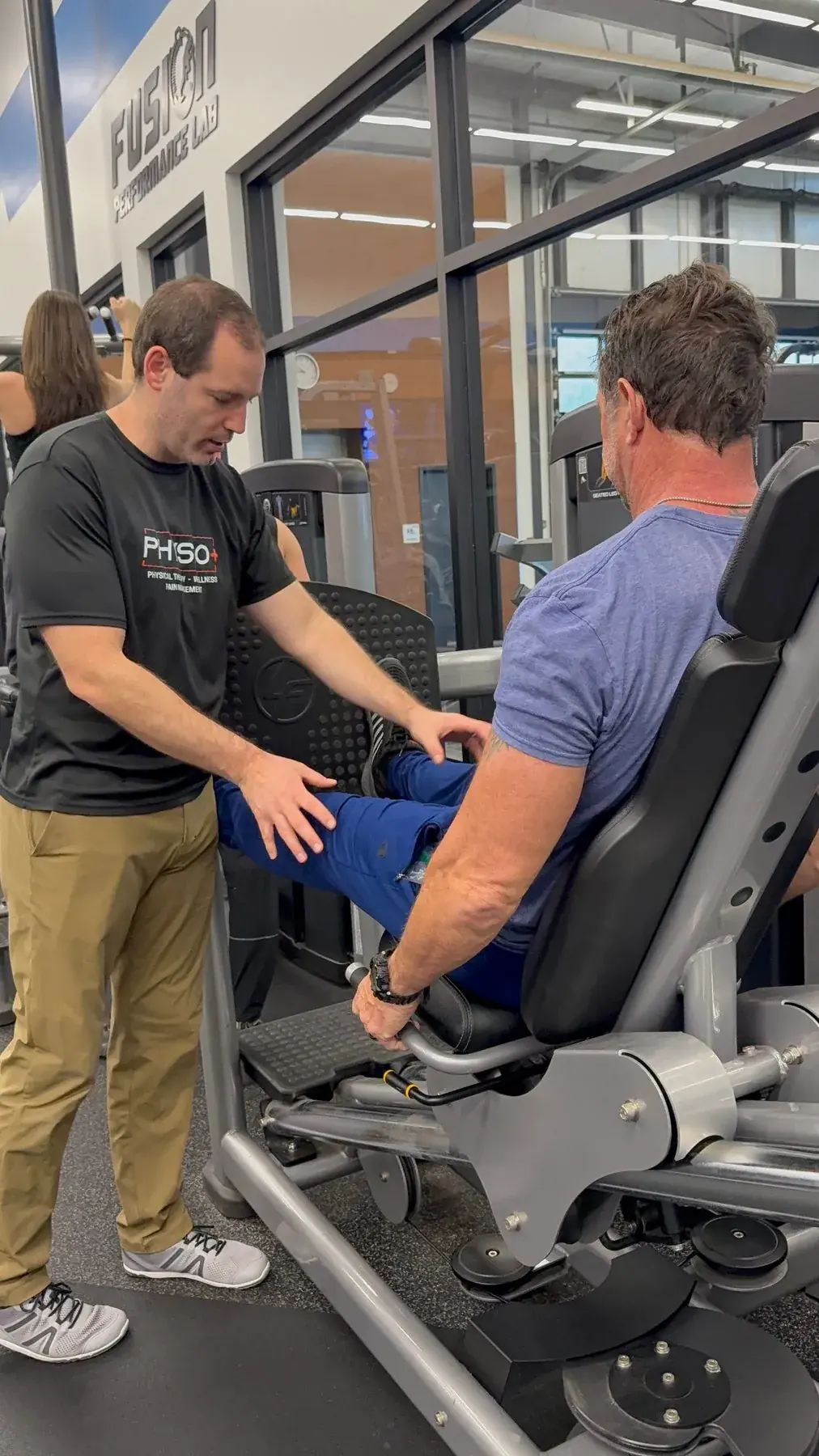
Our sport performance track runs inside Fusion Performance Lab, the strength floor attached to the clinic. Same doctor. Real barbells. Real return to sport.
Performance programming for athletes at every level. Golf, running, CrossFit, high school team sport. Built by a Certified Strength and Conditioning Specialist and golf performance work who also happens to be a doctor of physical therapy.
A real strength, conditioning, and movement program written for your sport, your body, and your schedule. Not a generic template pulled off an app. Built by a provider who can also flag the movement pattern that will cause your next injury.
We program for golfers chasing distance, runners with a race date, CrossFit athletes who want to keep hitting PRs past thirty five, and high school athletes whose parents want a real plan. Every program respects the rest of your life.
Our sport performance track runs inside Fusion Performance Lab, the strength floor attached to the clinic. Same doctor. Real barbells. Real return to sport.
Online concierge care for athletes who travel or train remote. Join the waitlist for first access.
Join the waitlist Related serviceVideo and in clinic analysis of your gait, swing, or lift. Pairs with sport performance for a full picture.
Explore RecoveryIn season recovery for overworked tissue. Certified providers only. Pairs with loading so the release holds.
ExploreThis is not for last Tuesday's sprain. If something is currently hurt, swollen, or limiting how you move, sports rehab is the right door and it starts with the same evaluation.
Sport performance is for the athlete who is training normally and wants to know what is actually limiting them. The high school thrower whose velocity has plateaued. The runner adding mileage who wants to know whether their hips will hold. The lifter whose squat stalls at the same depth every cycle. The masters athlete who is not injured but is noticing that recovery takes longer than it used to. None of them are patients in a flare. All of them have a measurable limiter they cannot see from the inside.
The reason a physical therapy clinic is a reasonable place to do this is that we already own the assessment half. Strength asymmetry, single leg control, ankle and hip range, trunk stiffness under load, and how movement quality falls apart as fatigue accumulates are the same measurements that drive a return to sport decision. Run them on a healthy athlete and they stop being a discharge test and start being a training plan.
The first session is an evaluation, not a workout. You will be tested, and you will leave knowing numbers about your own body that you did not have that morning.
What gets measured depends on the sport, but the shape is consistent: joint by joint range where it matters for your event, single leg strength and the asymmetry between sides, power and how quickly it is produced rather than just how much, and control under fatigue, because most athletes look fine on rep one and reveal the actual problem on rep twelve. Where video helps, biomechanical analysis gets used for gait and running mechanics.
Then the programming, which is the part most athletes are already doing badly. Not more volume. Load directed at the specific limiter the testing found, sequenced around your actual competition calendar rather than a generic twelve week block, and retested rather than assumed. If your left side produces 18 percent less force than your right, that is the number the plan attacks and the number we recheck.
Both clinics sit inside working gyms, Fusion in Lindale and FIT in Tyler, so the testing and the training happen on real racks, sleds, and turf rather than in a treatment room with a resistance band. That matters more for performance work than it does for anything else we do.
Rehab starts with a problem and works back to normal. Performance starts at normal and works toward better. They share the testing and they share the clinician, and they are not the same service. Rehab is measured against whether you can return to your sport safely. Performance is measured against whether you got faster, stronger, or more durable than you were in the first session.
The honest version of the overlap: plenty of athletes finish rehab and keep going into performance work, and that transition is usually the right call, because discharge at pain free leaves most of the strength deficit still sitting there. If that is where you are, you are already in the system and the plan just changes goal.
This is for athletes who are cleared, not for last week’s sprain. If you are currently injured, sports rehab is the right door.
It starts with the $195 initial evaluation, then $180 per session. That evaluation is what establishes whether performance work is the right track or whether you should be in rehab first.
No. Sport performance is for athletes who are cleared and want testing and load programming. If you are currently injured or in a flare, sports rehab is the right door and it starts with the same evaluation.
Performance is a plan, not a workout. We start with an evaluation, then build the program.