Focused and radial shockwave for tendinopathies, plantar fasciitis, and stubborn chronic pain that has not responded to standard rehab. Typical course is three to six sessions over a few weeks, paired with loaded exercise.
A handheld device delivers acoustic pressure waves into damaged tissue. The mechanical stimulus triggers a local healing response that standard rehab alone often cannot reach. Evidence based for tendons and fascia that have become chronic.
We use shockwave specifically for tissues that are stuck, most often the plantar fascia, patellar tendon, Achilles, gluteal tendons, and elbow tendons. Always paired with progressive loading. The combination is what works.
02How it works
From probe to program.
Four steps, and the probe is only one of them. The exam decides whether the tissue is a shockwave problem in the first place, and the loading that follows is what turns a treated tendon into a working one.
The handpiece delivers pulses through a gel coupling at a rate and intensity set for the tissue underneath. Most areas take a few minutes. It is uncomfortable rather than painful, and the intensity is dialled to what you can tolerate while still being worth doing, which is a conversation during the session, not a setting we pick for you.
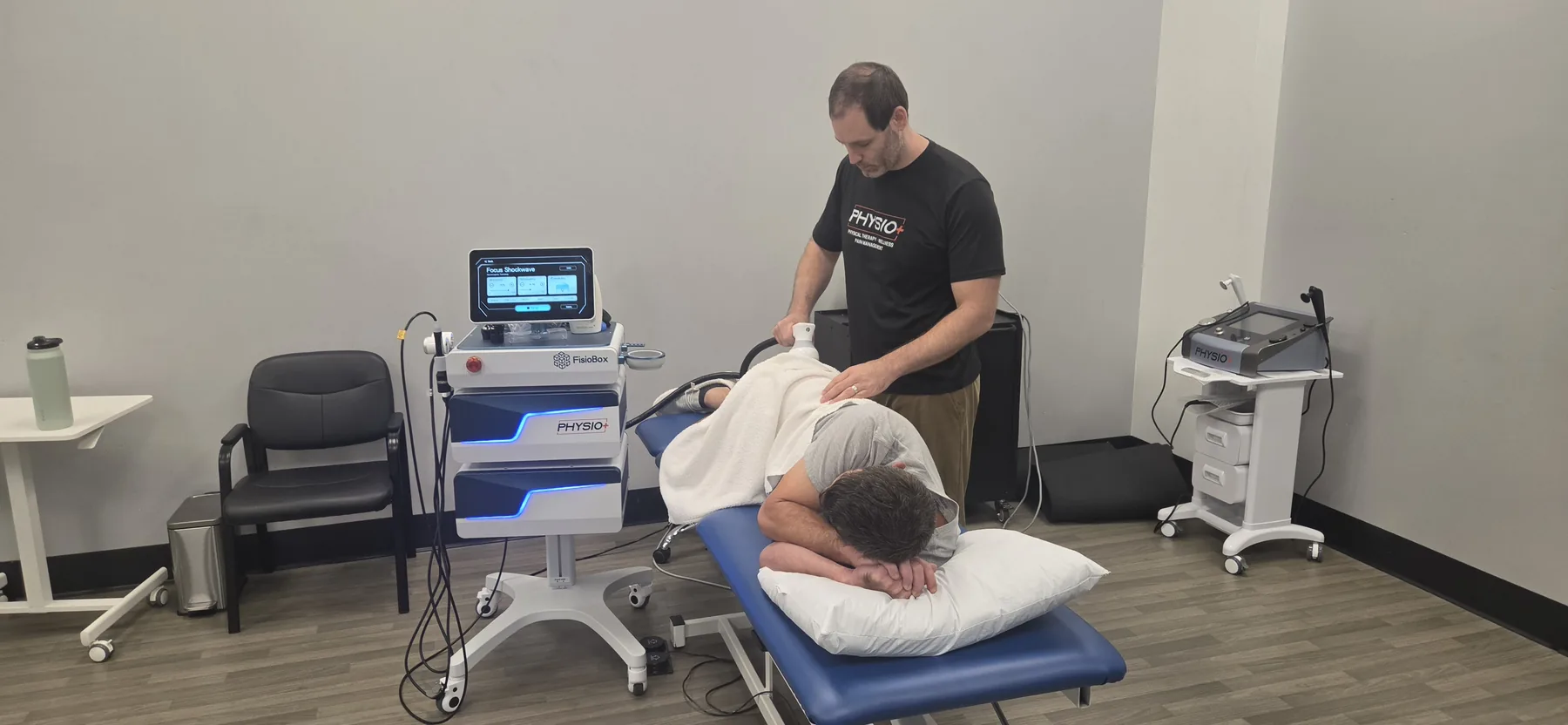
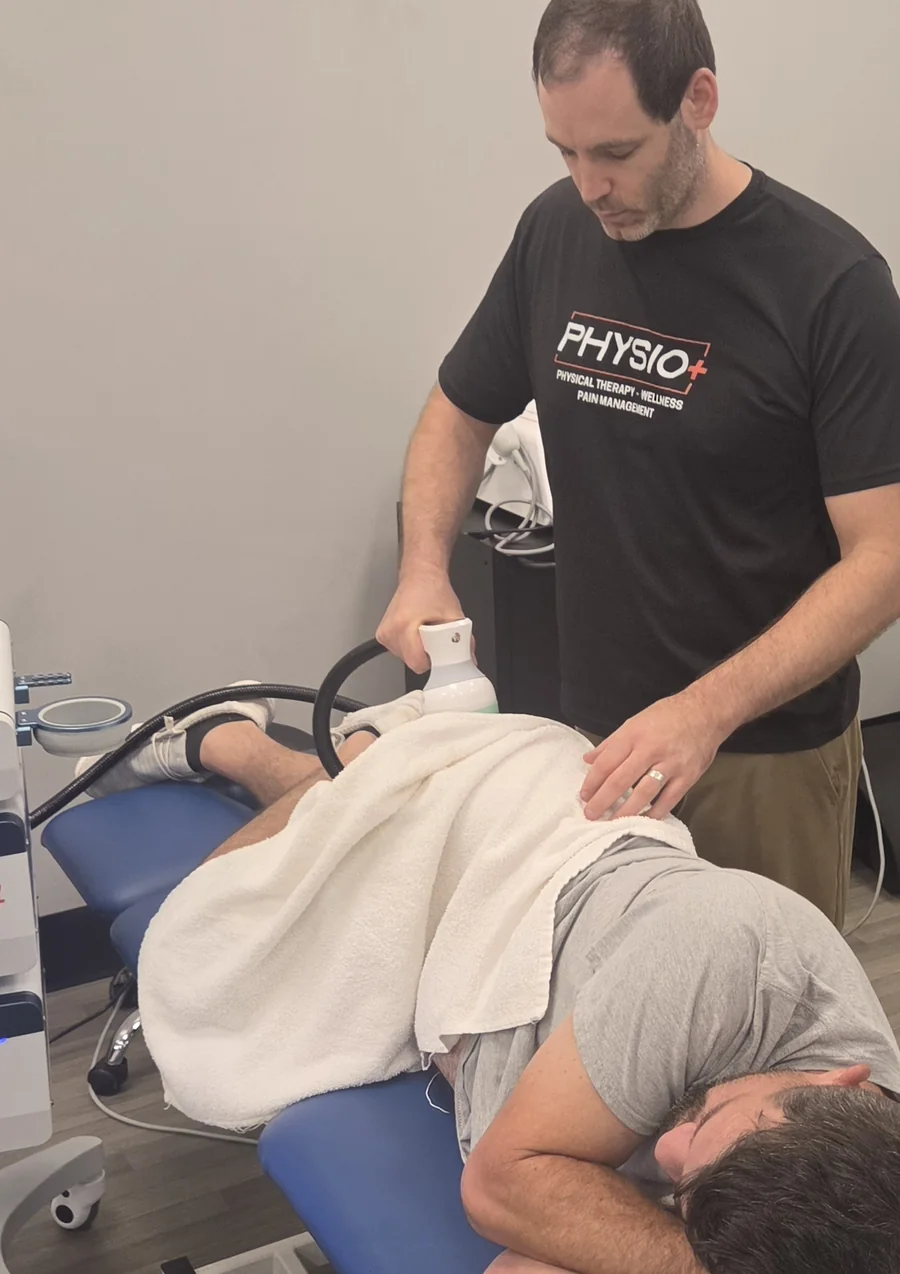
The handpiece, mid session. Pulses go through a gel coupling while the clinician's other hand keeps the tissue positioned. Twelve seconds of a session that usually runs a few minutes per area.
Step 01
Diagnostic exam to confirm tendinopathy pattern
Step 02
Targeted shockwave application to the involved tissue
Step 03
Progressive loading protocol introduced the same visit
Step 04
Re test at session three to adjust the plan
Focused shockwave at Fusion Lindale. The unit travels to the table rather than the other way round, and the session happens in the same room as the rest of your visit.
Shockwave is priced as a package because that is how it works. The evidence for extracorporeal shockwave therapy is built on courses of three to five sessions spaced about a week apart, not on one treatment. A single session tells you whether you tolerate it. It does not tell you whether it worked. If someone sells you one shockwave session and calls it treatment, you have bought a test, not a course.
One area, a few minutes. A course runs three to five sessions about a week apart, which is what the evidence is built on.
What it is actually good for
The strongest evidence is in stubborn tendon problems that have already failed a few months of loading: plantar fasciitis and heel pain, Achilles tendinopathy, patellar tendinopathy, gluteal tendinopathy at the outside of the hip, and lateral elbow pain. The common thread is a tendon that has stopped remodelling on its own. Shockwave delivers mechanical energy into the tissue to restart that process, which is a genuinely different mechanism from making something feel better for an afternoon.
Two honest caveats. First, shockwave is a second line option. It earns its place after a real loading programme has been tried and has stalled, not instead of one, and the research reflects that: it is studied in chronic cases, typically three months or longer. If your heel has hurt for two weeks, you do not need shockwave, you need a loading plan and some patience. Second, it works alongside that loading programme, not in place of it. Every course here is paired with exercise, because the sessions restart the tissue's response and the loading is what directs it.
What it feels like, and who should skip it
Firm, percussive, and uncomfortable at the spot that is already sore, for roughly five minutes. Most patients describe it as very tolerable once they know what is coming, and intensity is dialled to what you can handle rather than to a fixed setting. Some soreness for a day afterwards is normal and is not a sign anything went wrong. Skip it if you are pregnant, on anticoagulants, have a bleeding disorder, have an active infection or a tumour in the area, or have an open growth plate at the treatment site. We check all of that first.
Cash rates for every service are published on the insurance and cash pay page. Insurance coverage for shockwave is inconsistent between carriers, so we verify your benefits before the first session rather than after.
04Common questions
Frequently asked.
How much does shockwave therapy cost at Physio+?
The cash rate is $125 per session, or four sessions for $400, which works out to $100 each. Shockwave is priced as a course because that is how it is studied: three to five sessions about a week apart. One session is a tolerance test, not a treatment.
How many shockwave sessions will I need?
Usually three to five, spaced about a week apart, alongside a loading programme. If a full course has not changed anything, we say so rather than sell you a second course.
Does shockwave hurt?
It is firm and percussive at the spot that is already sore, for roughly five minutes. Intensity is dialled to what you can tolerate. Some soreness the next day is normal and is not a sign anything went wrong.
Is shockwave the first thing I should try?
No. It is a second line option that earns its place after a real loading programme has been tried and stalled, typically in cases that have been going three months or longer. If your heel has hurt for two weeks you need a loading plan, not shockwave.
Ready when you are
Start with the initial evaluation.
Shockwave is powerful for the right patient. We screen first so you do not spend money on something that will not work.