Service . Neuromuscular

Dry Needling in Lindale and Tyler.

Thin filament needling of trigger points and muscle tissue. Performed only by certified dry needling providers. Pairs with movement so the release holds.

Performed by Tim Hu, PT, DPT, OCS, C-DN; Logan Merritt, PT, DPT, NCS, Cert. DN; and Mike Giles, PT, DPT, Cert. DN, all three formally certified in dry needling. $120 a session at Fusion Lindale and FIT Tyler.

Dry needling, explained.

Dry needling uses a thin monofilament needle to release tight muscle tissue and reset the neuromuscular pattern. It is performed only by clinicians with formal certification. It is not acupuncture.

Included inside a standard PT visit. Often pairs with manual therapy and a specific loading plan so the effect lasts past the session.
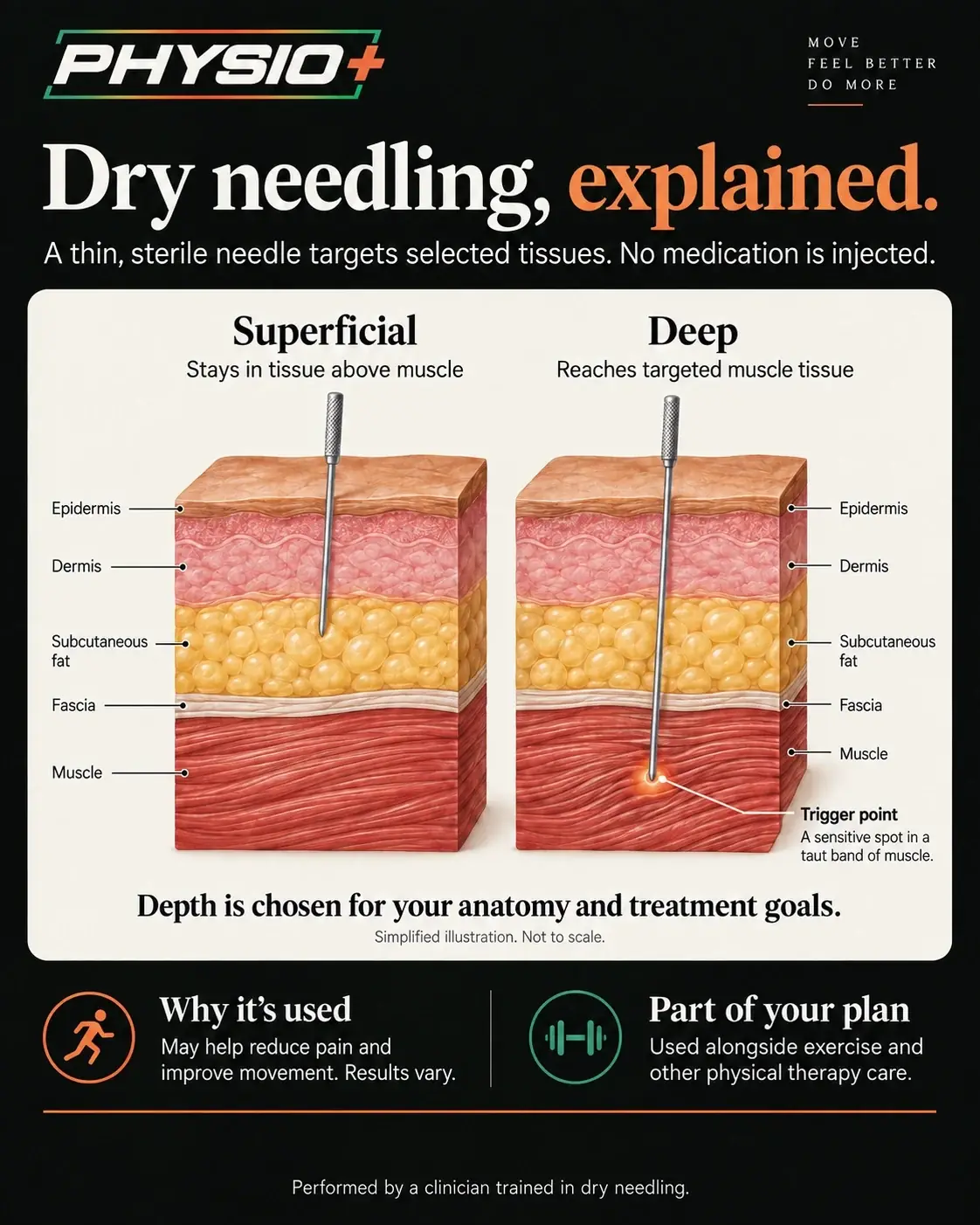
Physio+ diagram titled Dry needling explained. Two cross sections of skin and muscle side by side. On the left, superficial needling, where the needle stays in the tissue above the muscle. On the right, deep needling, where the needle reaches a trigger point in a taut band of muscle. Both panels label the epidermis, dermis, subcutaneous fat, fascia and muscle. Depth is chosen for your anatomy and treatment goals.
What the needle passes, and where it stops

Two needles, same tissue. Superficial work stays above the muscle. A deep taut band needs the tip inside it, and which one you get is decided by the muscle and what sits under it, never by preference.

  • Skin, 1 to 2 mm. The only layer most people register. Insertion gets rated 0 to 1 of 10, and the filament is 0.16 to 0.30 mm, a fraction of an injection needle.
  • Subcutaneous fat and fascia. Nothing much to feel in the fat. Crossing the fascia, the sheath the muscle slides inside, is often where a dull, deep ache starts.
  • Muscle and the trigger point. A sensitive spot in a taut band, usually 20 to 30 mm down. The band contracts and releases around the needle, which is the twitch: about a second, then it eases. That release is what opens the window the rest of the visit uses.

Simplified illustration, not to scale. Nothing is injected: the needle is what does the work, which is where the name comes from.
From screen to release.

Four steps, and you will know after the first one whether needling is worth continuing. Nothing here happens before the screen says it should.

Step 01
Trigger point and muscle screen

Palpation finds the taut band and reproduces your pain from it, and range of motion and strength get measured before anything happens. Those numbers are the control. Without them there is no way to tell whether the needle did anything.

Step 02
Targeted needling of the involved tissue

The needle goes into the band that reproduced the symptom, not wherever it hurts. Depth and angle are set by the anatomy under that spot. Most muscles take seconds, and you can call a stop at any point.

Step 03
Post treatment mobility work

Tone drops for a day or two, and that window is the whole point. Mobility and activation work happen in the same visit while the muscle will actually let you move, because a window nobody uses closes with nothing changed.

Step 04
Re assess function the same visit

The same measures from step one get repeated before you leave: range, strength, and the movement that hurt. Better means it earned its place in your plan. Flat means it comes out.

Dry needling helps with.

The patterns we needle most, by region. The gate is the same everywhere: muscle has to be the thing driving the pain, and the exam is what decides that.

Conditions treated with dry needling at Physio+ in Lindale and Tyler
RegionWhat we needlePatterns it shows up in
Head and neck Upper trapezius, levator scapulae, suboccipitals Tension and cervicogenic headaches, a neck that locks up after desk weeks, jaw tension that travels with it. See neck pain.
Shoulder and upper back Rotator cuff, rhomboids, mid trapezius Rotator cuff tendinopathy, impingement pain, the knot between the shoulder blades that massage quiets for a day. See shoulder pain.
Elbow and forearm Forearm extensors and flexors Tennis elbow and golfer's elbow, grip pain that returns every time load goes up. See elbow pain.
Low back and hip Quadratus lumborum, lumbar paraspinals, deep glutes Lumbar spasm after a flare, glute and piriformis tightness, sciatica pattern referral when muscle is guarding rather than a nerve root. See back pain and hip pain.
Knee and lower leg Quadriceps, calf complex, tibialis posterior Runner's knee and patellofemoral pain, calf trigger points, Achilles tendinopathy, plantar fasciitis and first step heel pain. See knee pain and foot and ankle pain.

Dry needling for back pain and sciatica.

The muscles that get needled for back pain are usually quadratus lumborum, the lumbar paraspinals, and the deep glutes when the pain runs into the hip or down the leg. Those muscles guard after a disc flare or a heavy Saturday, and the guarding often outlasts whatever started it.

Needling drops that tone for a day or two. What you do inside that window decides whether it holds: hinge work, side planks and bird dogs, and walking, which is what the back pain plan is built around anyway. Needling with no loading behind it is a fix that expires by Thursday.

One honest limit. When leg pain comes from an irritated nerve root rather than a guarding muscle, needling the muscle changes the guarding and not the nerve. The exam sorts that out before a needle comes out, and the answer changes the plan, not just the technique. Dry needling for back pain goes deeper into which pattern is which.

Each of those muscles refers pain somewhere predictable, which is what makes the screen worth anything. Quadratus lumborum refers along the crest of the hip and can read as a deep hip ache. Glute medius refers down the outside of the thigh. Piriformis refers into the buttock and sometimes further. None of that gets assumed: pressing the band has to reproduce the pain you came in with before a needle is opened.

What the window gets used for is specific. Hip hinge work so the load stops landing on a guarded low back, side planks and bird dogs for the trunk that was not holding, and walking, which does more for an irritable back than most exercises people expect us to prescribe. Two or three sessions is usually enough to know whether needling belongs in your plan at all.

Read the full back pain and sciatica plan, which covers the exam, the week to week progression, and when imaging actually changes anything.

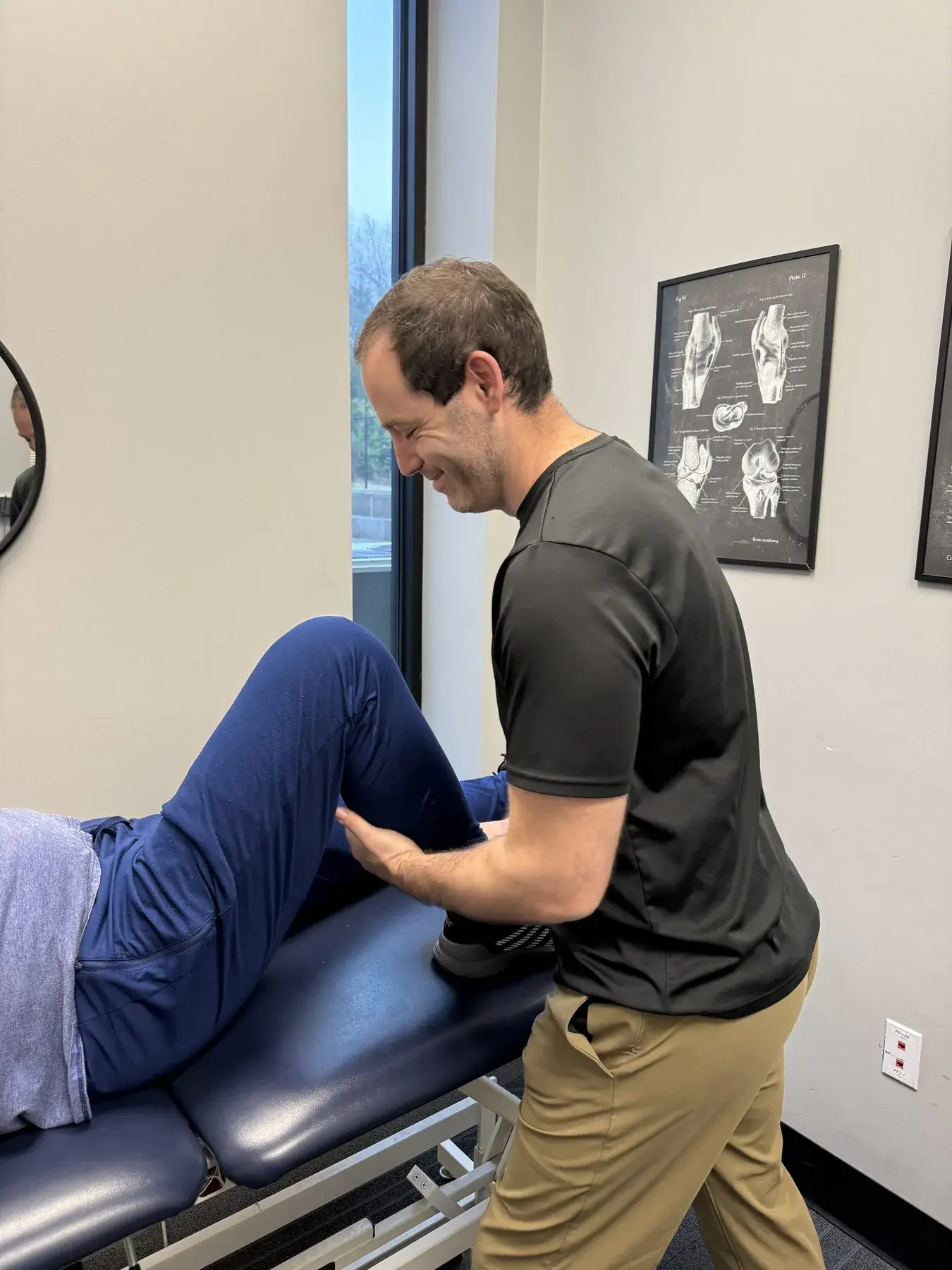
A Physio+ doctor of physical therapy assessing a patient's low back on the treatment table
The exam picks the muscle. Quadratus lumborum, the lumbar paraspinals, and the deep glutes all refer pain in their own pattern. Which one gets needled is decided on the table, not from the complaint.

Dry needling for neck pain.

Upper trapezius and levator scapulae are the two most needled muscles in the building. They are what locks up after a week of laptop days and a bad pillow, and they refer pain into the shoulder blade and up behind the ear, which is why people describe it as a knot that will not let go.

When headaches are the main complaint, the suboccipitals come into it too. Either way the needling buys range, and the range gets used the same visit: deep neck flexor work, mid back mobility, and the desk setup changes that stop it coming back. That is the neck pain plan, and needling is one tool inside it.

Some patients do best when needling and an adjustment happen in the same visit. Dry needling with adjustments covers when we combine the two and when we deliberately do not.

The referral map here is why people describe neck pain in places that are not the neck. Upper trapezius refers up the side of the neck and behind the ear, which is the pattern most often mistaken for a headache with its own cause. Levator scapulae refers into the corner where the neck meets the shoulder blade, the spot people reach for with the opposite hand. Suboccipitals refer behind the eye. Matching your description to the muscle that reproduces it is most of the exam.

After the needle, the visit goes to the things that decide whether it comes back: deep neck flexor work, mid back rotation, and the desk setup that created the problem. Monitor at eye height, forearms supported, and a break interval you will actually keep. Needling a trapezius every week for a screen that sits too low is a subscription, not a treatment.

Read the full neck pain, pinched nerve, and headache plan for the exam, the headache patterns that respond, and what week to week progress looks like.

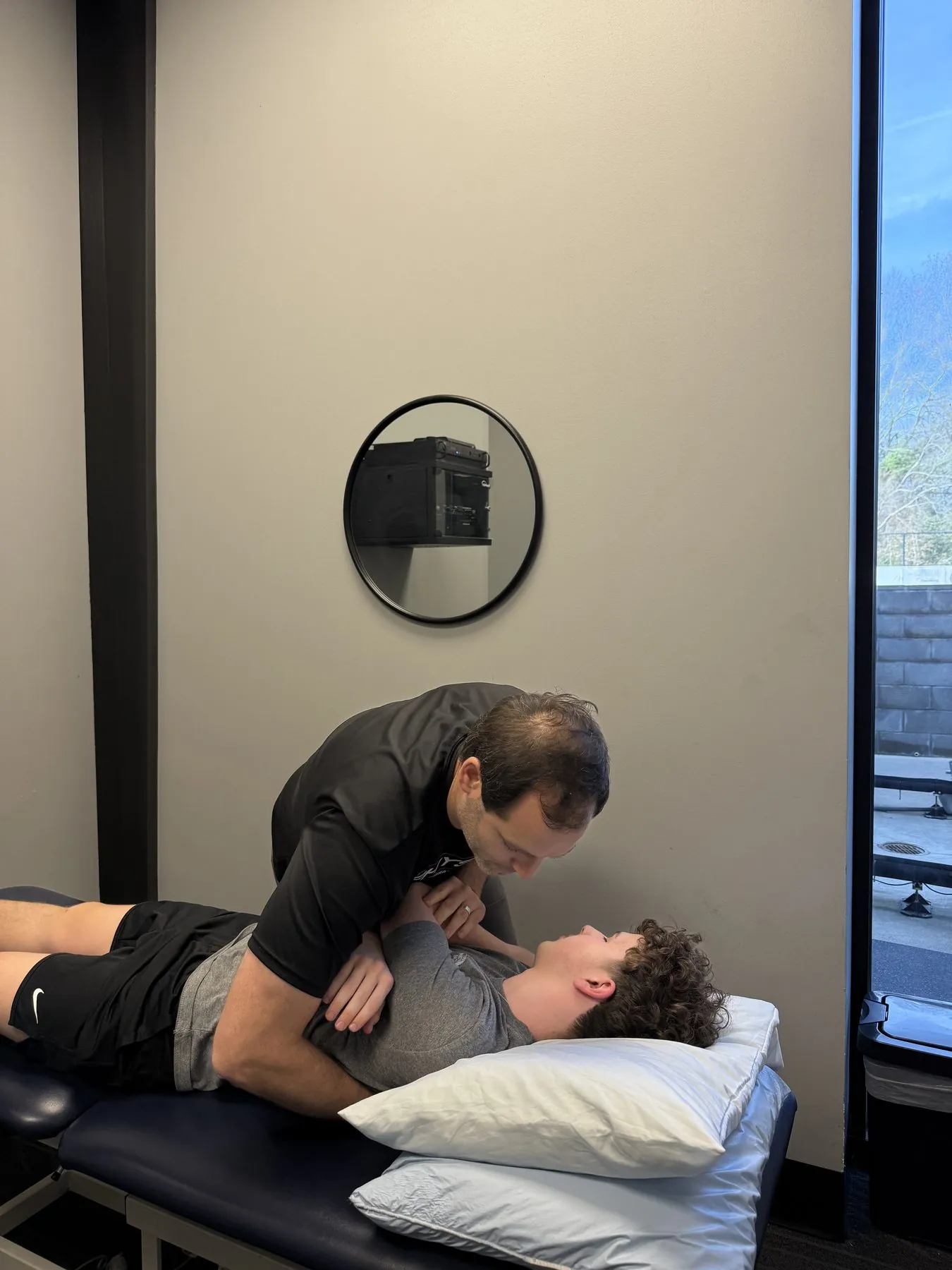
Hands on assessment of the neck and jaw at Physio+ before treatment
Upper trapezius and levator scapulae. The two most needled muscles in the building, and the reason a desk week ends with a knot behind the shoulder blade.

Dry needling in Lindale, TX.

Dry needling in Lindale is done at Physio+ inside Fusion Athletic Club, 140 E Eagle Spirit Dr. Sessions are one on one with a certified DPT, not a high volume mill. You do not need a gym membership. Free parking at the main entrance.

Hours are Monday to Friday, 7a to 6p, closed weekends, and same week appointments are often open. The Lindale clinic page has directions, the towns most patients drive in from, and what the first visit looks like.

Dry needling in Tyler, TX.

Dry needling in Tyler is at FIT, 2259 Broussard St. Same certified DPTs, same $120 session, same rule: we needle the muscle that is guarding the pattern we found in the exam, then we load it so it holds.

Same hours, Monday to Friday 7a to 6p, and free parking in the FIT lot. The Tyler clinic page has the map, the entrance to use, and the parking detail.

One twenty a session, or four for four hundred.

How much $120 a session or 4 for $400

Most people should not buy four on day one. Two or three sessions alongside your loading programme tell you whether needling is doing anything for you. Needling is not billed the same as your $195 evaluation.

Most people do not need a package. Dry needling tends to declare itself quickly: if two or three sessions alongside your loading programme have not changed anything, a fourth usually will not either, and we will say so rather than keep booking. The four session package exists for the patients who clearly respond and know they want a course, not as the default recommendation.

Insurance is a separate question and the answer varies more than patients expect. Some carriers cover dry needling inside a physical therapy plan of care, some treat it as a separate billable code, and some exclude it entirely. We verify your specific benefits before the first session so the answer arrives before the bill does. Every cash rate is published on the insurance and cash pay page, and the complete dry needling guide covers what it feels like, how it differs from acupuncture, and the safety record.

One thing worth being direct about: dry needling is an opener, not a treatment. It drops tone in a muscle that has been guarding, which buys a window where the strength and movement work actually lands. Bought on its own, repeatedly, without the loading that follows it, it becomes an expensive way to feel better until Thursday. Every clinician here uses it that way on purpose.

Not acupuncture.

Same style of needle, different everything else. Dry needling comes from Western anatomy and targets a muscle you can name. Acupuncture is a complete system from traditional Chinese medicine, practiced by licensed acupuncturists. Neither is the other one done badly.

Dry needling compared with acupuncture
Dry needlingAcupuncture
Framework Western anatomy and a movement exam Traditional Chinese medicine, meridians and qi
Target A specific trigger point in a named muscle Points along energy pathways across the body
Goal Drop the guarding, restore range, then load it Restore balance, including for systemic complaints
Who performs it A doctor of physical therapy with a needling certification A licensed acupuncturist, over 1,000 hours in that framework

The complete dry needling guide goes further into the mechanism, the evidence, and what the twitch response actually is.

Who dry needling is not for.

Needle phobia is not a disqualifier, and it is worth saying out loud. Plenty of patients get where they are going with manual therapy, shockwave, and the loading that follows either one. Say so at the evaluation and the plan gets built without it, with no speech about it.

There are situations we screen before needling anyone: pregnancy, a bleeding disorder or blood thinning medication, an active infection or an open wound over the target muscle, lymphedema in that limb, an implant or port near the site, and simply being unwell that day. Some of those are a no, some only move the target or the timing, and your clinician tells you which one applies to you rather than leaving you to guess.

The screen is not a formality. It happens at the evaluation and again at each visit, because the answer can change between visits. And because needling is an opener rather than the plan, taking it off the table changes how a visit is spent, not where you end up.

Frequently asked about dry needling.

Does dry needling hurt?

Most patients feel a quick, deep cramp when the muscle twitches, then it releases. The needle itself is hair thin and most insertions are barely felt. The twitch lasts a second and is usually described as strange rather than painful.

01
How many sessions will I need?

Acute problems typically respond in 2 to 4 sessions. Chronic patterns run 4 to 8. We reassess at every visit and stop needling the moment it stops earning its place in your plan.

02
Will I be sore afterward?

Often, for 24 to 48 hours. It feels like a hard workout in the treated muscle, not sharp pain. Water, movement, and heat settle it faster. Soreness beyond 48 hours is worth a call.

03
Does insurance cover dry needling?

Coverage varies by plan when needling is part of a physical therapy plan of care. We verify your benefits before your first session so you know the exact cost walking in.

04
Is dry needling the same as acupuncture?

No. Different framework, different training, different goals. Dry needling targets specific trigger points and nerve tissue based on your movement exam. Our complete guide covers the differences in depth. See the complete dry needling guide.

05
Do I need a referral?

No. Texas direct access law (HB 4099) allows up to 30 days of physical therapy care, including dry needling, without a physician referral. Book the initial evaluation directly.

06
Can I book dry needling only?

Start with the initial evaluation. Needling happens inside a visit, when the exam says a specific muscle is guarding the pattern we found, which is the only way it earns its place. Once you are a patient here and needling is part of your plan, a needling focused follow up is straightforward to book at $120, or 4 for $400.

07
Ready when you are

Start with the initial evaluation.

Dry needling is part of a real plan, not a magic fix. We decide together if it belongs in yours.

Site by NOiC . no1iscoming.com