In short
The exercises with the strongest evidence for ordinary low back pain are not stretches. They are capacity builders: the McGill big three (modified curl up, side plank, bird dog), the glute bridge and the hip hinge. They take 10 to 15 minutes, they are done most days rather than occasionally, and they train the trunk and hip strength that recurrent back pain tends to be missing. Guidelines from the American College of Physicians and NICE both put exercise and self care ahead of imaging and medication for back pain without red flags. [1][2]
What a list of exercises cannot tell you is which pattern you have, how much load your back currently tolerates, or whether your symptoms belong to this category at all. That is what an evaluation is for. If you are in Lindale or Tyler, you can book an evaluation without a referral.
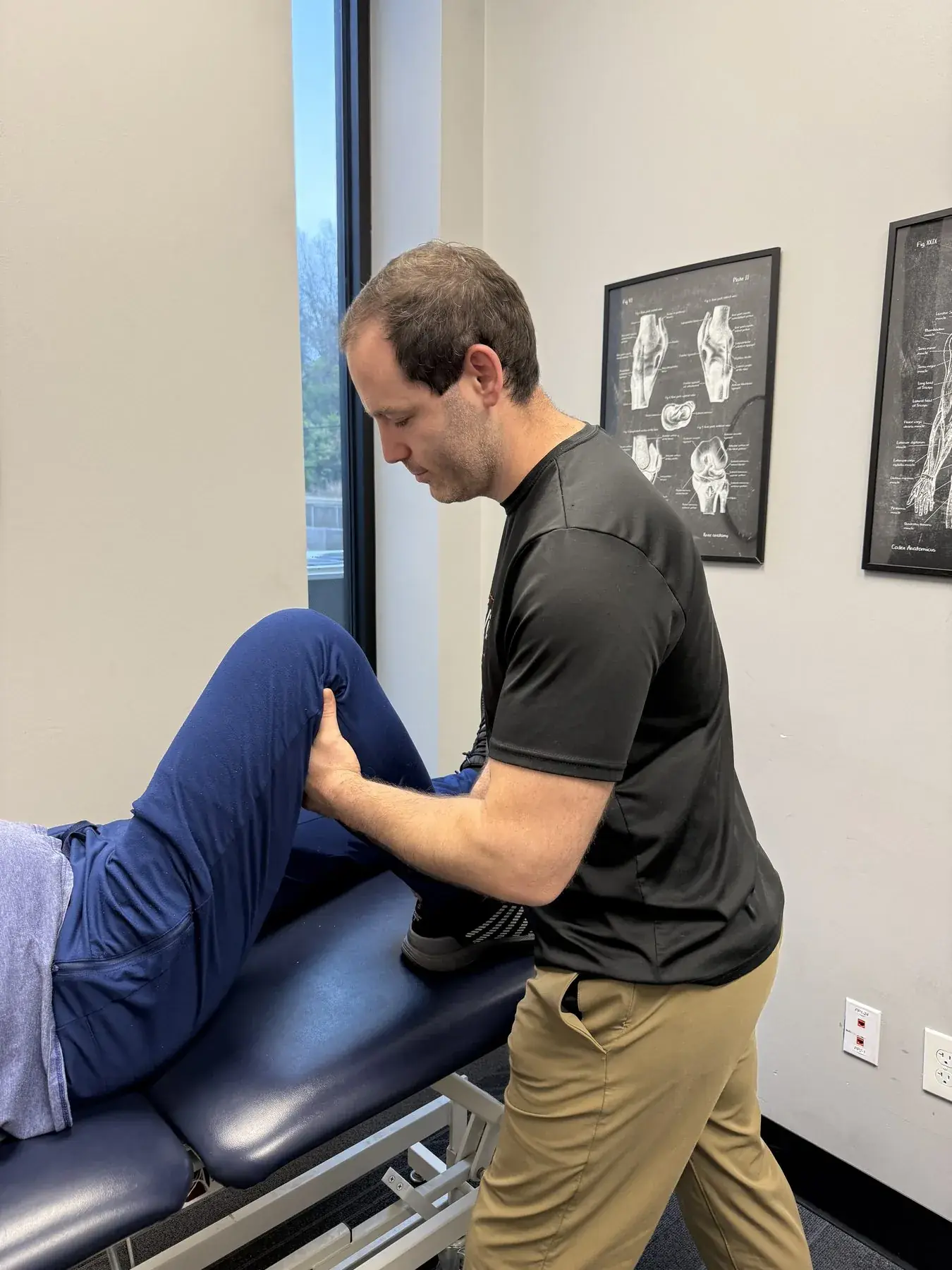
Should you stretch or strengthen a sore back?
Most back pain advice online is stretching, because stretching feels productive. A stretch gives a few minutes of relief by temporarily reducing the sensation of tightness. That relief is real, and it is also why the same stretch gets repeated for months without the problem changing.
Tightness is usually a symptom, not the cause. A back that aches by mid afternoon is often a back being asked to hold a position longer than its current endurance allows. Stretching does not add endurance. Loading does.
This matters most if a disc is involved, where repeated end range flexion can make symptoms worse rather than better. We wrote that up separately in why stretching can make a disc bulge feel worse, and the companion piece on positions that take pressure off a disc bulge.
The practical rule: stretch for comfort if it helps you move, but do not expect it to change the pattern. The five movements below are the ones that change the pattern.
The five with the strongest evidence
The first three come from the spine research of Stuart McGill, who studied which trunk exercises build stability with the least compressive cost to the spine. The last two address the hip, because a hip that does not share load leaves the low back doing the work. [3]
1. Modified curl up
Lie on your back. One knee bent with the foot flat, the other leg straight. Slide your hands under your low back so the natural curve is preserved. Lift your head and shoulders just off the floor, about the height of a paperback. Hold 10 seconds. Lower.
Dose. 10 reps, 10 second holds, most days. This is not a sit up. The hands under the back are the entire point: they stop you flattening the spine and loading the disc.
2. Side plank
On your side, forearm under your shoulder. Lift the hips so you make a straight line from shoulder to knee (easier) or shoulder to foot (harder). Hold 10 seconds. Lower with control.
Dose. 5 reps per side, 10 second holds, most days. This trains the side of the trunk, the quadratus lumborum and obliques, which is the part most home programs skip entirely.
3. Bird dog
On hands and knees. Extend the opposite arm and leg until both are level with your torso. Hold 10 seconds. Return and alternate. The torso should not rotate. If someone set a glass of water on your low back, it should not spill.
Dose. 10 reps per side, most days. This is the one that transfers to walking and standing, because it trains the trunk to resist rotation while the limbs move.
4. Glute bridge
On your back, knees bent, feet flat and close enough that your fingertips brush your heels. Squeeze the glutes first, then lift the hips. Hold one second at the top. Lower with control.
Dose. 3 sets of 15, most days. If you feel this mostly in your hamstrings or low back rather than your glutes, move your feet slightly closer and start the lift with the squeeze rather than the push.
5. Hip hinge pattern
Feet shoulder width, hands on the hips or holding a light kettlebell. Push the hips backward and let the torso tip forward while the spine stays neutral. Go only as far as you can without the low back rounding. Return by driving through the heels.
Dose. 3 sets of 10, most days. The hinge is the foundation of every back safe lift, from picking up a toddler to a loaded deadlift. Learning it unloaded is what makes the loaded version safe later.
How do you sequence a week?
All five, most days, for six weeks. Ten to fifteen minutes. There is no split routine and no rest day structure to manage, because the doses are deliberately small enough to repeat.
If you miss a day, do not make it up with extra volume the next day. Frequency is doing the work here, not intensity. A short session you actually complete five times a week beats a long one you complete twice.
Add a daily walk. Twenty minutes is enough. Walking is the cheapest thing you can do for a back and it is the first thing people drop when they hurt.
How long before back exercises work?
Many people notice less morning stiffness inside the first week or two. That early change is a sign the plan is tolerable, not a sign it is finished.
Meaningful change in how much your back tolerates usually takes four to six weeks of consistency, which is roughly what the exercise therapy literature reports for chronic low back pain. [4] Capacity is built slowly and lost quickly, so the six week mark is a checkpoint, not a finish line.
Track something other than pain. Minutes you can sit before symptoms start, whether you can load the dishwasher without bracing, how you feel the morning after a long drive. Pain alone is a noisy measure and it will talk you out of a plan that is working.
What if an exercise makes your back hurt more?
Some discomfort while working is expected. A clear increase in symptoms is information, and it should change what you do next.
- If a movement produces pain above roughly 4 out of 10, stop that movement for the day.
- Return to an easier version the next day rather than abandoning it entirely. Shorter holds, fewer reps, smaller range.
- If the increase lasts more than two or three days, stop guessing and get assessed.
- If symptoms travel further down the leg than before, stop. Symptoms spreading outward is the one pattern that should not be worked through at home.
Are these safe with a disc bulge?
Often yes, with pain guided dosing, and the curl up is the one to watch. If it increases leg symptoms, leave it out and keep the other four. The side plank and bird dog are usually well tolerated because neither requires bending the spine.
A disc problem also changes which positions help between sessions, which is a different question from which exercises to do. That is covered in detail in positions for disc bulge pain, the most read guide on this site.
When exercises are not enough
A home program is the right first move for ordinary mechanical back pain. It is not the right move for everything, and some presentations need assessment before any exercise at all. Book an evaluation if:
- Symptoms have lasted longer than six weeks.
- Pain reliably wakes you at night.
- You have numbness, pins and needles, or weakness in a leg or foot.
- Pain is keeping you from work or normal daily activity.
- You have been consistent for three weeks and nothing has moved.
Seek urgent medical care for loss of bladder or bowel control, numbness around the groin or inner thighs, or sudden leg weakness. Those are not physical therapy problems and they are time sensitive.
What comes after the five?
Once the five are genuinely easy, the next layer is load. This is the part most back pain programs never reach, which is why so many people stay in a cycle of getting better and then re-injuring.
- Loaded hinge: kettlebell deadlift, then barbell.
- Loaded squat: goblet, then barbell.
- Carries: farmer and suitcase holds.
- Single leg work: split squats and step ups.
This is the handoff from rehab to training, and it is the reason both Physio+ clinics sit inside gyms. Sport Performance picks the progression up for patients ready to load.
Getting assessed in Lindale or Tyler
Texas direct access means you can be evaluated by a doctor of physical therapy for up to 30 calendar days without a physician referral. How direct access works covers the detail.
An evaluation is an hour, one on one, with a doctor of physical therapy. You leave with a plan you understand and a program scaled to what your back currently tolerates, rather than a printout of generic exercises. Fusion Lindale and FIT Tyler, and we bill insurance as well as taking cash pay.
Frequently asked questions
Can you do these with active back pain?
Usually yes, scaled down, if symptoms are moderate and you have none of the red flags above. Reduce the hold times and the reps before you reduce the frequency.
Do you need any equipment?
No. A light kettlebell or dumbbell makes the hinge easier to learn, but all five work with body weight and a floor.
What is the single best exercise for lower back pain?
There is not one. The reason these five are grouped is that they cover different jobs: front, side, rotation control, hip extension and the hinge. Picking one is how people end up strong in a single direction and sore in the others.
Is walking good for lower back pain?
Yes, and it is underrated. Walking loads the back in a way that is usually well tolerated and it keeps you from the long static positions that tend to aggravate symptoms. Twenty minutes most days.
Do you have to do these forever?
Not at this dose. Once you move into loaded work, the loaded patterns cover the same capacity. Many people keep the bird dog and side plank as a warm up because they take two minutes.
What if these exercises make it worse?
Scale down first and give it a day or two. If it keeps getting worse, or symptoms move further down the leg, that is a reason to be assessed rather than a reason to push harder.
Sources
- Qaseem A, et al. Noninvasive Treatments for Acute, Subacute, and Chronic Low Back Pain: A Clinical Practice Guideline From the American College of Physicians. Annals of Internal Medicine, 2017. acpjournals.org
- NICE guideline NG59. Low back pain and sciatica in over 16s: assessment and management. nice.org.uk
- McGill SM. Low Back Disorders: Evidence Based Prevention and Rehabilitation. The modified curl up, side plank and bird dog are commonly referred to as the big three.
- Hayden JA, et al. Exercise therapy for chronic low back pain. Cochrane Database of Systematic Reviews, 2021. cochranelibrary.com
This guide is general information, not a diagnosis or a treatment plan for your back. Reviewed by Tim Hu, PT, DPT, OCS, C-DN, Board Certified Orthopedic Clinical Specialist.