Balance + vestibular
How to sleep with vertigo (BPPV): which side, and how high.
Sleep with the affected ear up, and your head raised at least 20 degrees on a wedge or two pillows. That is what I ask of my BPPV patients while it is active, and for 48 hours after a repositioning maneuver. It gets you through the night. It does not clear BPPV. A maneuver matched to the right canal and the right ear does that, usually in 1 to 3 visits. I treat it at Physio+ in Lindale, Texas.
Why does lying down set it off?
BPPV stands for benign paroxysmal positional vertigo. Your inner ear holds tiny calcium crystals that belong in one chamber. When a few drift into one of the semicircular canals, certain head positions set them rolling, and the canal reports a spin that is not happening. The spin is brief, usually well under a minute, and it stops when the crystals settle. [2]
Bed is where those head positions live: lying back, rolling over, sitting up, and tipping your head to look at the clock. Nothing is damaged. Something is misplaced. That is why the answer is mechanical, and why the way you lie down matters while you wait to have it treated.
One clue I listen for in the history: spinning that starts when you roll over in bed is more likely to be the horizontal canal, and spinning that starts when you sit up or lie back is more likely to be the posterior canal. It is a clue, not a diagnosis. Testing settles it, and the maneuver that fixes each one is different.
Which side should you sleep on with BPPV?
Affected ear up. In the most common type, the crystals sit in the posterior canal of one ear, and lying back with that ear toward the mattress is the position that sets them moving. It is the same position a clinician uses on purpose in the Dix-Hallpike test to find the problem: the head turned 45 degrees toward the ear being tested, then laid back with that ear down. [1] So the rule for the night is the reverse of the test. Bad ear up.
Your body may already know this. In a 2012 study of 342 people with BPPV, the side they habitually fell asleep on matched the affected ear far more often than chance. [4] In a 2013 study of 150 patients, 73 of the 88 who were given no sleep instructions at all avoided their affected side on their own. [3]
What my patients tell me is that when they keep the affected ear up, it comes back less often. I pass that on, and I am clear about what it is: their reports, not a trial result.
How high should your head be?
At least 20 degrees off horizontal. A foam wedge holds that angle all night. Two firm pillows work if they do not slide apart by 3 a.m. A recliner is more than you need, though it is fine for a night if that is where you can sleep.
What the research can and cannot tell you: the 2013 study above had one group sleep semi upright at about 30 degrees. [3] No trial settles a best angle. Raising your head is a comfort measure for the nights before treatment and the two nights after it, not a cure.
How do you get in and out of bed without setting it off?
Slowly. The slower the better while BPPV is active. Limit head movement and keep everything in a straight line: no twisting, no quick turns of the head.
- Lying down: sit on the edge of the bed, lower yourself onto your side with your head already supported, then roll onto your back if that is where you sleep. Head and shoulders move together.
- Turning over: log roll. Keep your head in line with your body and turn as one piece.
- Getting up: roll to your side first, push up to sitting, and sit for a slow count of 30 before you stand.
- At night: leave a light on between the bed and the bathroom.
The reason for the care is falls, not the spinning itself. The specialty guideline asks clinicians to talk with every BPPV patient about safety, and getting up fast in the dark is where people go down. [2] If your balance has been slipping in general, our guide to balance and age covers the 90 second screen we use.
Do you have to sleep sitting up after the Epley maneuver?
Not according to the specialty guideline. For years patients were sent home from a repositioning maneuver with rules: 48 hours upright in a recliner, sometimes a neck collar. In 2017 the American Academy of Otolaryngology clinical practice guideline, which the American Physical Therapy Association endorses, made a strong recommendation against those postural restrictions after repositioning for posterior canal BPPV. The trials did not show that they improve the result. [1] [2]
Here is what I ask for anyway, and why. For 48 hours after the maneuver, sleep with the affected ear up and your head raised at least 20 degrees. Two reasons. First, in the 2013 study, the patients who slept on their treated side during the first week had more early recurrences, 35.3 percent, than those who slept in other positions. Sleep positions were reported by the patients and their families, at one hospital, so it shows a link, not a cause. [3] Second, my own patients report fewer returns when they do it. Neither is a trial. The cost of two nights on a wedge is low, so I ask, and I tell people exactly how strong the evidence is.
If your BPPV is in the horizontal canal, it is treated with a different set of maneuvers, and I give no sleep directions afterward.
Which ear is it?
You cannot reliably tell which canal, or which ear, is involved without testing. You can get symptoms rolling to both sides even though only one ear is the problem. It is also not uncommon to have BPPV in both ears. So test. The right ear is affected more often than the left, and the likely reason is simply that most people are right handed and sleep on their right side, which fits what the sleep side studies found. [3] [4]
Testing is positional: the Dix-Hallpike test for the posterior canal and a supine roll test for the horizontal canal, with your eyes watched for the pattern each canal produces. [1] The maneuver depends on it. The Epley begins with you sitting with your legs out straight, head turned 45 degrees toward the affected ear, chin tucked. That is the loading position, and it only loads the right canal if you have the right ear. A maneuver aimed at the wrong side is a few minutes of spinning for nothing.
Can the way you sleep cause BPPV, or bring it back?
Possibly, and no one can say for sure. The studies above link the side people sleep on with the ear that gets BPPV. The specialty society lists long periods lying in bed among the things BPPV can be associated with, alongside head injury, migraine, other inner ear problems, diabetes and osteoporosis. Most cases, it notes, happen for no reason anyone can find. [2]
BPPV can come back after it has been cleared, which is why the guideline asks clinicians to say so up front. [2] If it does, the same testing and the same kind of maneuver apply. You do not have to start from zero.
What a sleeping position cannot do
It cannot move the crystals back where they belong. Avoiding the trigger is how you get through the night. It is not a treatment.
A Cochrane review found the Epley maneuver clearly outperforms sham treatment for clearing both the crystals and the vertigo. [5] The catch is targeting. There are three canals in each ear, and a maneuver only works when it matches the affected canal and side. That is why positional testing comes first, and why the video version so often fails: it is aimed at a guess. The guideline also recommends against routinely treating BPPV with suppressant medication such as meclizine, which blunts the spinning and does nothing for the crystals. [1] Watchful waiting with follow up is an option in the guideline, because BPPV can settle on its own over time. [2] A maneuver is usually faster.
When is dizziness at night not BPPV?
BPPV has a signature: brief spinning, set off by a change in head position, gone in under a minute. Dizziness that is constant for hours and does not change with position is a different problem, and it needs an evaluation rather than a pillow change.
Call 911 for sudden dizziness with any of these. They are stroke signs, and a stroke in the back of the brain can imitate an inner ear problem convincingly.
- Double vision, slurred speech, or one sided facial droop
- New weakness, numbness, or clumsiness in an arm or leg
- Sudden inability to walk or stand that was not there yesterday
- A thunderclap headache alongside the vertigo
- Fainting or near fainting with chest pain, palpitations, or shortness of breath
- New dizziness with sudden hearing loss in one ear
Dizziness that travels with a stiff neck and headaches can start in the neck rather than the ear. We test for both; this guide explains that overlap.
What a visit looks like
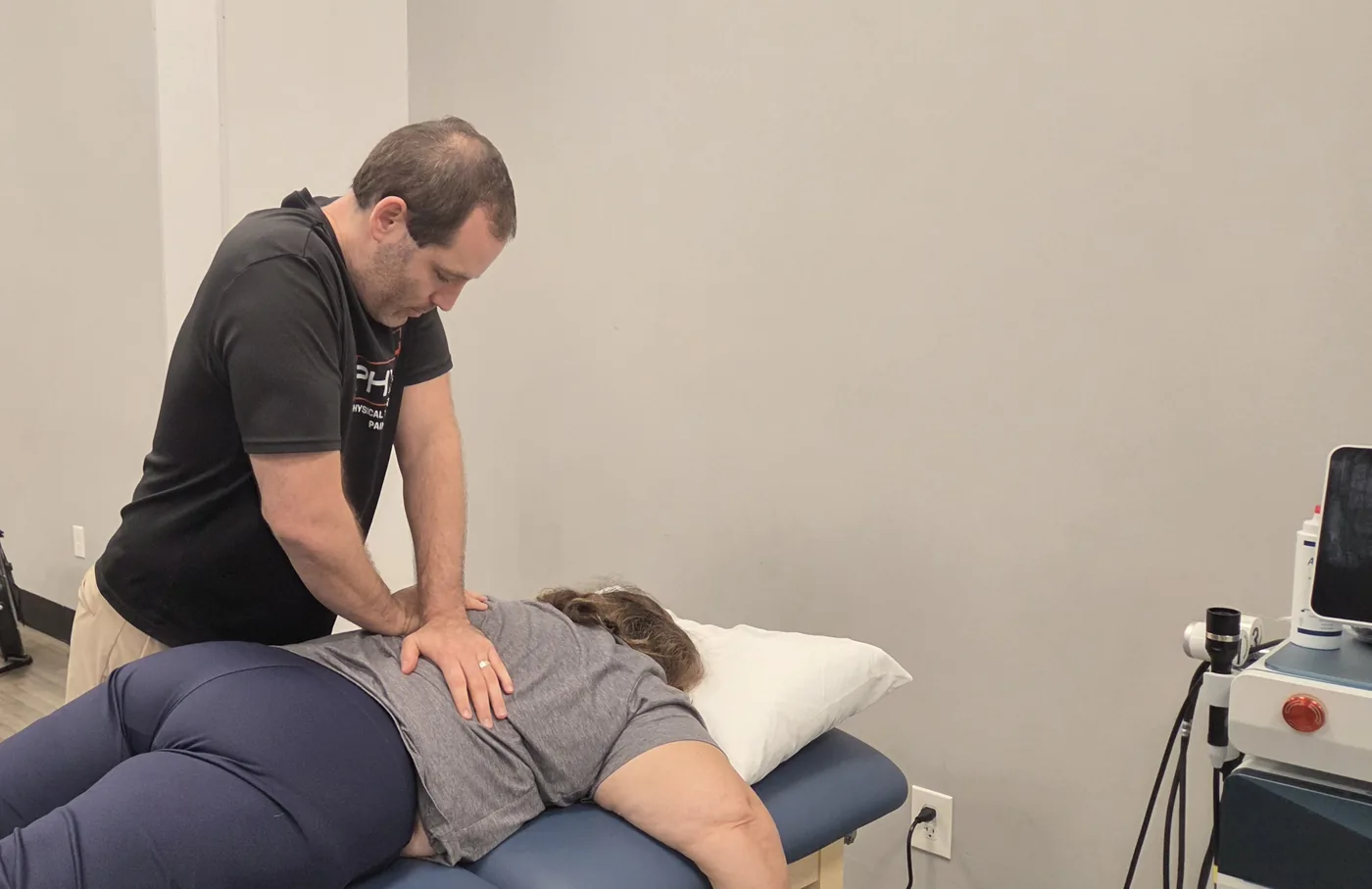
A dizziness evaluation at Physio+ runs 60 minutes, one on one with me at the Lindale clinic. It covers your dizziness history, eye movement testing, and positional testing including the Dix-Hallpike test. The testing can briefly bring the spinning on. That is the diagnostic point. If BPPV is confirmed, repositioning starts in the same visit. If your dizziness is easily triggered, have someone drive you to this one.
Texas allows up to 30 days of physical therapy care without a referral, so you do not need to see another clinician first. The full picture of what we treat, from BPPV to post concussion dizziness and fall risk, is on the balance and vestibular guide, and the clinic level walkthrough is on the vestibular therapy page.
Questions about sleeping with vertigo
What side should I sleep on with vertigo?
Sleep with the affected ear up, on the side that does not set off the spinning. With the most common type of BPPV, lying with the affected ear down is the position that moves the crystals. If you do not know which ear it is, positional testing is the only reliable way to find out.
Should I sleep sitting up with BPPV?
Not fully upright. Raising your head at least 20 degrees on a wedge or two pillows is usually enough while BPPV is active. The specialty guideline does not require any sleep restriction after a repositioning maneuver; Logan Merritt still asks his patients for 48 hours of affected ear up and head raised, and tells them that the evidence for it is patient reports, not a trial.
How soon after the Epley maneuver can I lie flat?
The 2017 guideline from the American Academy of Otolaryngology, which the American Physical Therapy Association endorses, found no evidence that sleep restrictions after the maneuver improve the result and recommends against requiring them. At Physio+ the request is 48 hours of head raised and affected ear up as a low cost precaution, then sleep however you like.
Can sleeping on one side cause vertigo?
Studies of people with BPPV find that the ear affected matches the side they habitually sleep on more often than chance. That is an association, not proof that one causes the other. Most cases of BPPV have no cause anyone can find.
Does BPPV go away without treatment?
It can settle on its own, and the guideline allows watchful waiting with follow up. A repositioning maneuver matched to the right canal and side usually clears it faster, in 1 to 3 visits, and testing first is what makes the maneuver land.
Why is my vertigo worse when I roll over in bed?
Rolling changes the position of your head against gravity, which sets the loose crystals moving inside the canal. The canal reports a spin until they settle, usually in under a minute. Spinning brought on by rolling in bed points toward the horizontal canal; spinning brought on by sitting up or lying back points toward the posterior canal. Testing confirms which.
Stop managing the night. Get it cleared.
Physio+ offers one hour, one on one visits with a doctor of physical therapy. Vestibular care is based in Lindale. Book an evaluation, or call or text 903.492.5215. Sudden dizziness with stroke signs needs emergency care first.
Book with Logan in Lindale
Logan Merritt is the founder of Physio+ and a Board Certified Neurologic Clinical Specialist, a credential held by under 3 percent of physical therapists in the United States. Vertigo, dizziness after concussion, and fall risk are a core part of his practice. Read Logan's background and areas of care.
Call 903.492.5215 or text the clinic for scheduling help.
General education, not a diagnosis or a personalized treatment plan.
Sources behind this guide
- Bhattacharyya N, Gubbels SP, Schwartz SR, et al. Clinical practice guideline: benign paroxysmal positional vertigo (update). Otolaryngol Head Neck Surg. 2017;156(3 Suppl):S1-S47. Diagnosis by Dix-Hallpike and supine roll test, the strong recommendation against postprocedural postural restrictions, and the recommendation against routine vestibular suppressants.
- American Academy of Otolaryngology, Head and Neck Surgery Foundation: BPPV guideline fact sheet, 2017. Endorsements including the American Physical Therapy Association, associations of BPPV, observation as an option, and education on safety and recurrence.
- Li S, Tian L, Han Z, Wang J. Impact of postmaneuver sleep position on recurrence of benign paroxysmal positional vertigo. PLoS One. 2013;8(12):e83566. 150 patients; sleep positions self reported.
- Shim DB, Kim JH, Park KC, Song MH, Park HJ. Correlation between the head-lying side during sleep and the affected side by benign paroxysmal positional vertigo. Laryngoscope. 2012;122(4):873-876.
- Hilton MP, Pinder DK. The Epley (canalith repositioning) manoeuvre for benign paroxysmal positional vertigo. Cochrane Database Syst Rev. 2014;(12):CD003162.